On This Page
What it looks like
***************************
APPLICATION FAILED TO START
***************************

Description:

Error creating bean with name 'serviceA': Requested bean is currently in creation:
Is there an unresolvable circular reference?

Action:

Consider declaring the factory method as static for relaxed binding
Or more verbosely:
org.springframework.beans.factory.BeanCurrentlyInCreationException:
Error creating bean with name 'serviceA': Requested bean is currently in creation:
Is there an unresolvable circular reference?
You’ll often see something like:
Caused by: org.springframework.beans.factory.BeanCurrentlyInCreationException:
Error creating bean with name 'serviceA': Requested bean is currently in creation:
Is there an unresolvable circular reference?
Why it happens
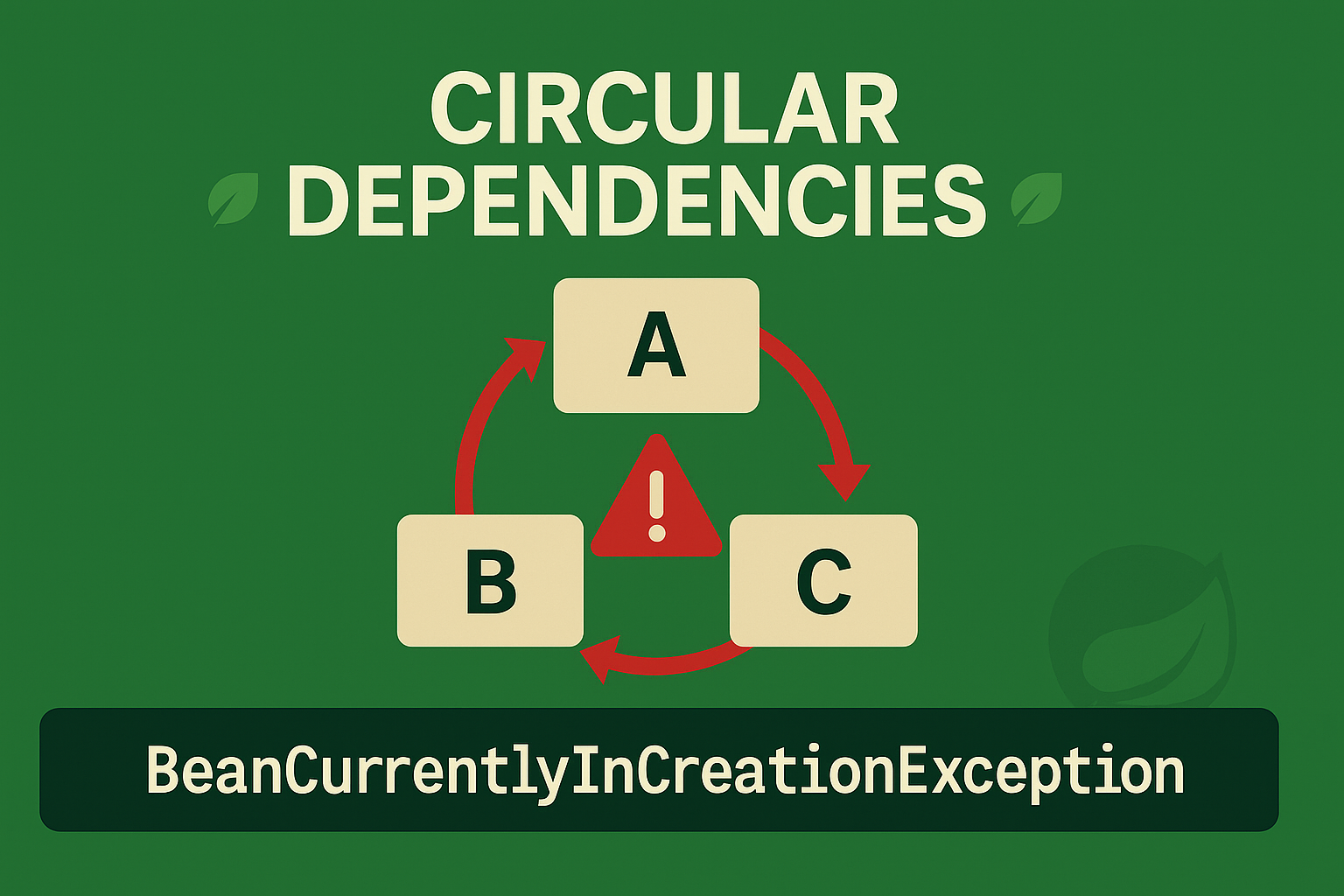
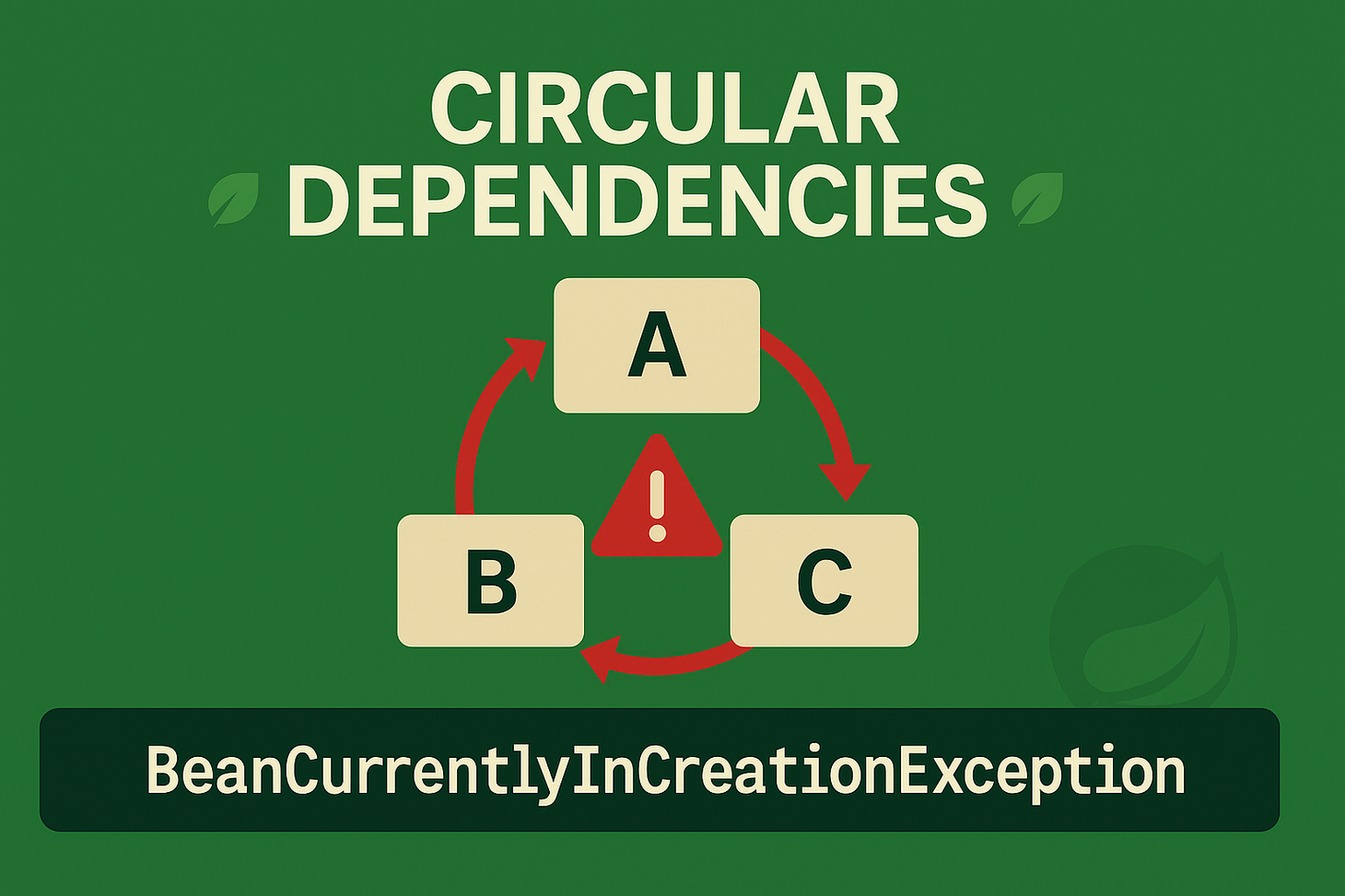
Spring’s default constructor‐injection model is acyclic. If A depends on B, and B depends on A (directly or via a chain), Spring can’t determine which to instantiate first, so it blows up.
Common culprits:
- Two
@Serviceor@Componentclasses each@Autowiredinto one another. - Controller ↔ Service, Service ↔ Repository cycles.
- A config class with
@Beanmethods that call each other in a loop.
How to fix it
Refactor to eliminate the cycle (best practice)
Circular dependencies often violate the Single Responsibility Principle or the Dependency Inversion Principle. Ask:
- Can I introduce a third abstraction or mediator to break the loop?
- Should one service publish an event rather than call back directly?
- Could one side depend on an interface rather than a concrete class?
public interface NotificationSender {
    void send(Notification n);
}

@Service
@RequiredArgsConstructor
class EmailSender implements NotificationSender {
    // ...
}

@Service
@RequiredArgsConstructor
class OrderService {
    private final NotificationSender sender;
    // no direct dependency on EmailSender
}
Use setter (or field) injection with @Lazy
If a true cycle is unavoidable, you can defer one dependency until runtime:
@Service
public class ServiceA {
    private final ServiceB serviceB;

    public ServiceA(@Lazy ServiceB serviceB) {
        this.serviceB = serviceB;
    }
}

@Service
public class ServiceB {
    private ServiceA serviceA;

    @Autowired
    public void setServiceA(@Lazy ServiceA serviceA) {
        this.serviceA = serviceA;
    }
}
This tells Spring: “Don’t try to create this dependency until the context is fully initialized.”
Tip: Prefer constructor‐injection for immutability; only fall back to setter‐injection when you need @Lazy.Static @Bean factory methods
If your cycle is within a @Configuration class:
@Configuration
public class AppConfig {

    @Bean
    public static A a(B b) {  // note `static`
        return new A(b);
    }

    @Bean
    public static B b(A a) {
        return new B(a);
    }
}
Declaring factory methods static relaxes ordering constraints, since Spring can call them without instantiating the configuration class.
Diagnostic checklist
- Spot the cycle: Trace the dependency chain in your stack‐trace.
- Search for mutual
@Autowired: Do any two beans inject each other? - Check config classes: Are any
@Beanmethods referencing one another? - Review design: Could a mediator or event‐driven approach break the cycle?
- As a last resort: Apply
@Lazyor static beans to defer instantiation.
Example
// BAD: circular dependency
@Service
public class UserService {
    private final OrderService orderService;
    public UserService(OrderService orderService) {
        this.orderService = orderService;
    }
}

@Service
public class OrderService {
    private final UserService userService;
    public OrderService(UserService userService) {
        this.userService = userService;
    }
}
Fix by refactoring:
- Extract a
UserContextinterface that only exposes methods OrderService really needs. - Have
UserServiceimplement it. - Inject the interface into
OrderServiceso there’s no two‐way loop.
public interface UserContext {
    User getCurrentUser();
}

@Service
@RequiredArgsConstructor
public class UserService implements UserContext {
    public User getCurrentUser() { /* … */ }
    // other user-related logic
}

@Service
@RequiredArgsConstructor
public class OrderService {
    private final UserContext userContext;
    // now no direct dependency on UserService
}
By breaking the cycle, you restore a clean, maintainable architecture that adheres to SOLID principles—and Spring will start up without a hitch.

GopiGorantala — Java, Spring, Kafka, Flink, Distributed systems Newsletter
Join the newsletter to receive the latest updates in your inbox.